

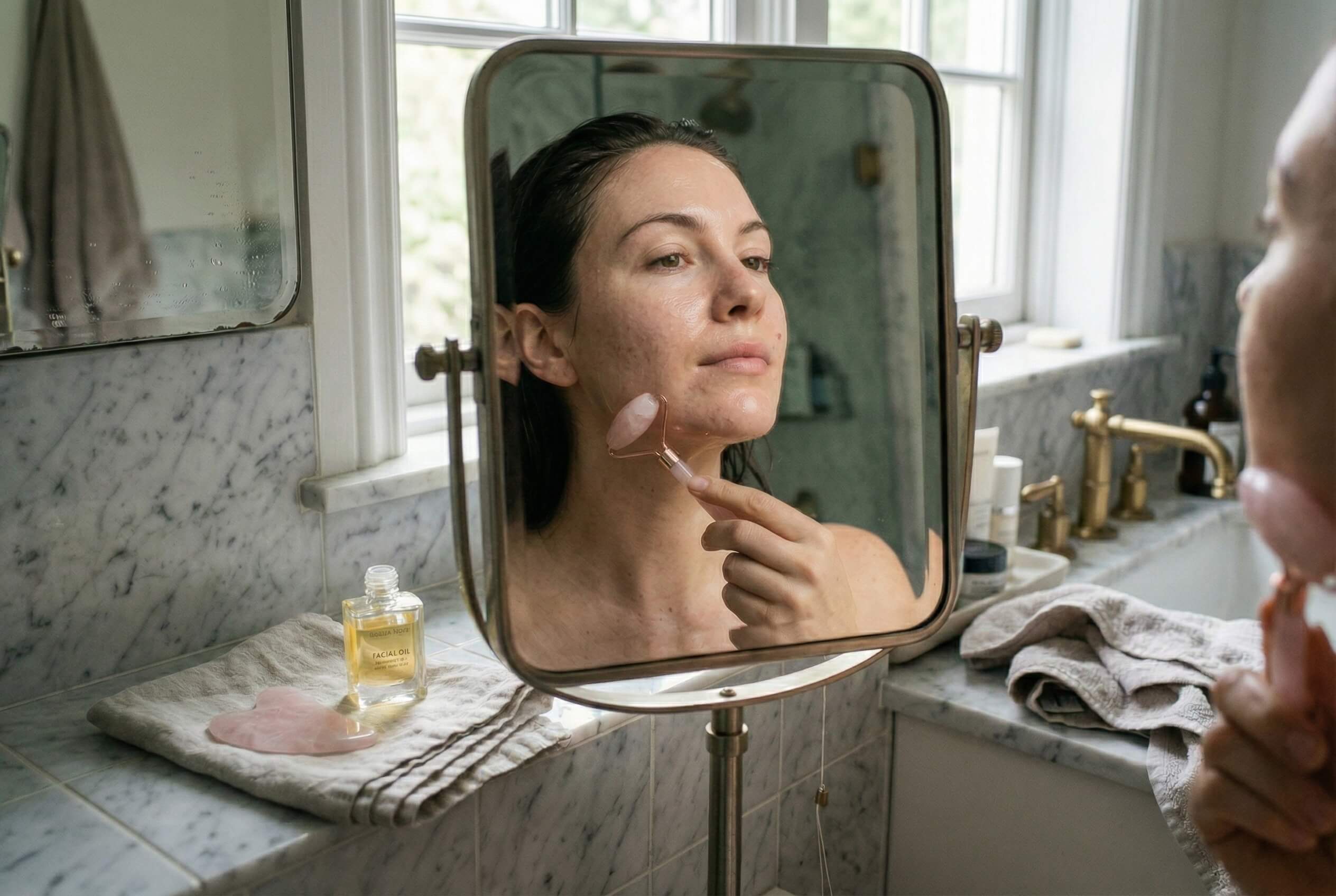
Your Nighttime Skincare Routine
Is Missing This One Step
The reason your serums aren't working overnight — and the fix takes 30 seconds.
- Your skin enters peak repair mode between 10 pm and 2 am — the quality of your sleep surface directly affects that window.
- Layering products thinnest to thickest isn't a preference. It's physics. Wrong order means actives can't reach their target.
- Step 8 — your sleep environment — is where most routines silently fail, regardless of what you spent on step 5.
- Cotton pillowcases are designed to absorb. That's the same reason they quietly pull your serum, face oil, and moisturizer off your skin overnight.
- For women over 40, declining estrogen changes barrier function and hydration retention — making every step of the nighttime routine count more, not less.
Why Your Skin Is Doing Something Remarkable Right Now
Somewhere between 10 pm and 2 am tonight, your skin is going to shift into peak repair mode. Cell turnover accelerates. Collagen synthesis ramps up. Blood flow to the skin's surface increases. Your body is running a full maintenance crew on your face — and unlike the rest of your day, nothing is competing for its attention.
This isn't wellness marketing. It follows circadian biology. Your skin's ability to absorb active ingredients is measurably higher at night, when the stratum corneum — your outermost skin layer — becomes more permeable. That serum you smooth on at 10:30 pm has a genuinely better chance of reaching its target than the same serum applied at 8 am.
During the day, your skin is in defense mode: protecting against UV, pollution, and environmental stress. At night, it shifts into repair mode. Products applied before sleep work with that biology, not against it.

The window between 10 pm and 2 am is when your skin absorbs active ingredients most efficiently.
Here's what most skincare content doesn't say: the vast majority of people are getting steps one through seven right. They're double cleansing. They're layering their actives in order. They're dotting on eye cream just like the instructions said.
And then they press their face into a cotton pillowcase — and unknowingly hand half of that investment back. Step 8 is the one the beauty industry never bothered to write about, probably because it isn't something you can sell in a dropper bottle.
"Your skin repair window peaks at 10 pm. Most people end their routine at step 7. The routine doesn't end there — it ends when your face hits the pillow."
Why Order Matters More Than Products
Before we get to step 8, let's clear up the one that still trips people up: sequencing. You've probably heard you should layer "thin to thick" — and that's true. But the reason matters more than the rule.
Skincare products work by delivering active molecules to specific layers of your skin. The lighter, water-based formulas — toners, essences, serums — are designed to travel deeper. The heavier, oil-based formulas — moisturizers, face oils — are designed to sit closer to the surface and seal everything in.
When you apply a thick cream before a serum, you've built a wall. The serum can't get through. You're applying it to the cream, not to your skin.
"The wrong order doesn't just reduce effectiveness — in some cases it reverses it. You're trapping ingredients outside the skin you're trying to treat."
Painting a wall: you prime first, paint second, seal last. If you apply the sealant before the paint, you've wasted both. Skincare is no different. The golden rule isn't arbitrary — it's the only sequence in which the layers can actually do their jobs.
The Complete 8-Step Night Routine
Here's what a properly sequenced evening routine looks like — including the step that's almost always left off the list.
-
1Oil or Balm Cleanser — Dissolve
Start with an oil-based cleanser if you wore makeup or SPF. It binds to oil-based residue — sunscreen, foundation, sebum — and lifts it away without stripping. SPF is designed to be waterproof; a water-based cleanser alone won't fully remove it. Massage for 60 seconds, then rinse.
-
2Water-Based Cleanser — Cleanse
Your actual face wash. Use a gentle, pH-balanced formula that removes sweat and pollution without tightening. If your skin feels tight after cleansing, your cleanser is compromising your barrier before the rest of your routine even starts.
-
3Toner or Essence — Prep
A hydrating toner restores your skin's pH balance after cleansing and begins layering in hydration. A well-hydrated surface allows active ingredients to absorb more evenly. Press into skin with clean hands rather than wiping.
-
4Treatment Serum — Target
This is where your actives live: retinoids, peptides, niacinamide, AHAs. Pick the one that addresses your primary concern and use it consistently. If you're using retinol, start with two nights per week. Applying every night immediately is one of the fastest ways to cause irritation and then blame the product.
-
5Eye Cream — Protect
The skin around your eyes is three to five times thinner than the rest of your face. Use your ring finger (the gentlest one) and dot from the inner corner outward along the orbital bone. A little goes further than you think.
-
6Moisturizer — Hydrate
At night, you can use something richer and more occlusive than your daytime formula. Your skin isn't under makeup, so the heavier texture works with your skin's overnight repair rather than against it. Look for ceramides, hyaluronic acid, and squalane.
-
7Face Oil — Seal
Face oil goes last because it creates an occlusive layer over everything beneath it. It slows transepidermal water loss — the passive evaporation of moisture from your skin into the air overnight. Press onto skin; don't drag. Rosehip, marula, and squalane are gentle options for most skin types.
-
8Your Sleep Surface — The Missing Step
This is where the routine actually ends — or continues working, depending on your setup. The moment your face meets your pillowcase, a new variable enters the equation. Cotton is hygroscopic by design: it absorbs moisture. That's what makes it a great towel. It's also the same reason it's quietly pulling the face oil, moisturizer, and serum residue off your skin while you sleep — all night long.
Cotton is a cellulose fiber. Silk is a protein fiber. Their molecular structures are fundamentally different — and that difference determines how they interact with your skin overnight.
Cotton's absorbency draws moisture from whatever it contacts. Silk's smooth protein structure creates a non-absorbent, low-friction surface. Your ceramide moisturizer stays where you put it. Your face oil stays on your skin. Eight hours of uninterrupted product contact is not a small thing.
A Special Note If You're Over 40

Everything above applies to everyone. But if you're in your 40s or beyond, the stakes of each step are higher — and the missing step matters even more.
After 40, estrogen levels begin to decline. That shift has direct consequences for your skin: estrogen plays a role in collagen production, skin thickness, moisture retention, and barrier function. As levels drop, skin can become drier, more fragile, and slower to recover from friction and irritation.
The natural lipid content of your skin decreases too, which means transepidermal water loss becomes a bigger overnight problem. Whatever you sealed in at step 7 has a harder time staying there — especially if what's waiting for it is an absorbent cotton surface.
"In your 40s, your skin's repair window is still real. It's just less forgiving of the things that work against it."
This is also the decade when sleep quality tends to shift. Hormonal changes affect sleep depth and continuity, which means the repair window may be shorter or more fragmented than it used to be. Anything you can do to optimize the hours you do get — minimizing friction, minimizing product loss — is worth doing.
3 Mistakes That Undo Everything
Mistake #1 — Applying Retinol on Damp Skin
Retinol absorbs more aggressively on wet skin, which increases irritation risk without proportionally increasing efficacy. Always wait for your toner to fully absorb before applying any retinoid — 30 seconds is enough. If you're new to retinoids, try the "sandwich method": a thin layer of moisturizer, then retinol, then a second layer of moisturizer. This buffers delivery without eliminating the benefit.
Mistake #2 — Stacking Too Many Actives
More actives doesn't mean better results. Some combinations — retinoids with AHAs, for example — can destabilize each other or cause serious irritation when used together. If you're using both, alternate nights rather than stacking. A consistent three-ingredient routine that your skin tolerates will always outperform an ambitious ten-product stack that it's silently rejecting.
Mistake #3 — Sleeping in a Warm, Dry Room
Central heating dramatically lowers indoor humidity, especially in winter. Dry air accelerates transepidermal water loss — even through a face oil. A bedside humidifier set between 40–60% relative humidity can meaningfully support nighttime hydration. Combined with a non-absorbent sleep surface, you're creating conditions where your skin can actually hold onto what you applied.
"A consistent three-ingredient routine that your skin tolerates will always outperform an ambitious ten-product stack that it's quietly rejecting."
The 30-Second Fix
You don't need to rebuild your entire routine. You need to close the loop on it.
Step 8 is a switch, not a system overhaul. Switching your pillowcase is a 30-second change that extends the work of every step that came before it. What you're looking for is a smooth, non-absorbent surface with a fine weave — one that your skin can rest against for eight hours without friction or product transfer.
The pillowcase as the final step
At Home Nest Art, we designed The Luminous™ Silk Pillowcase with exactly this function in mind — not as a beauty accessory, but as the logical conclusion to an evening routine. It's 100% Grade 6A mulberry silk, woven at 22 momme: heavy enough to have real structure, smooth enough that your skin glides rather than drags against it overnight.
The difference isn't something you have to take on faith. Silk is a protein fiber, which means its molecular structure is non-absorbent in the way cotton isn't. Your ceramide moisturizer stays on your skin. Your face oil stays where you placed it. Your retinol serum has the entire night to do its work without the fabric quietly undoing it. That's not a luxury claim — that's your routine actually finishing.
OEKO-TEX certified. Independently tested for harmful substances. Because it's against your face for a third of your life.

The Luminous™ Silk Pillowcase
$89
The last step in your nighttime routine. Non-absorbent, low-friction, and designed to work with your skin — not against it.
Shop NowYour Complete Routine: Quick-Reference Checklist
- Step 1 · Oil Cleanser — dissolve SPF, makeup, and surface buildup
- Step 2 · Water-Based Cleanser — cleanse down to skin level
- Step 3 · Toner or Essence — restore pH, begin hydration layering
- Step 4 · Treatment Serum — deliver targeted actives to skin
- Step 5 · Eye Cream — protect the thinnest, most delicate skin
- Step 6 · Moisturizer — hydrate and lightly seal serums
- Step 7 · Face Oil — reduce water loss, lock everything in
- Step 8 · Sleep Surface — a non-absorbent pillowcase that keeps your routine on your skin, not on the fabric
Your nighttime routine is already doing more than you probably realize. The repair cycle is real, the biology is on your side, and the ingredients in your lineup are genuinely capable of making a difference. The only thing worth asking is whether your sleep environment is working with that process — or quietly working against it.
Step 8 costs 30 seconds. Start there tonight.
"Your home should ask nothing of you.
It should give everything back."


